
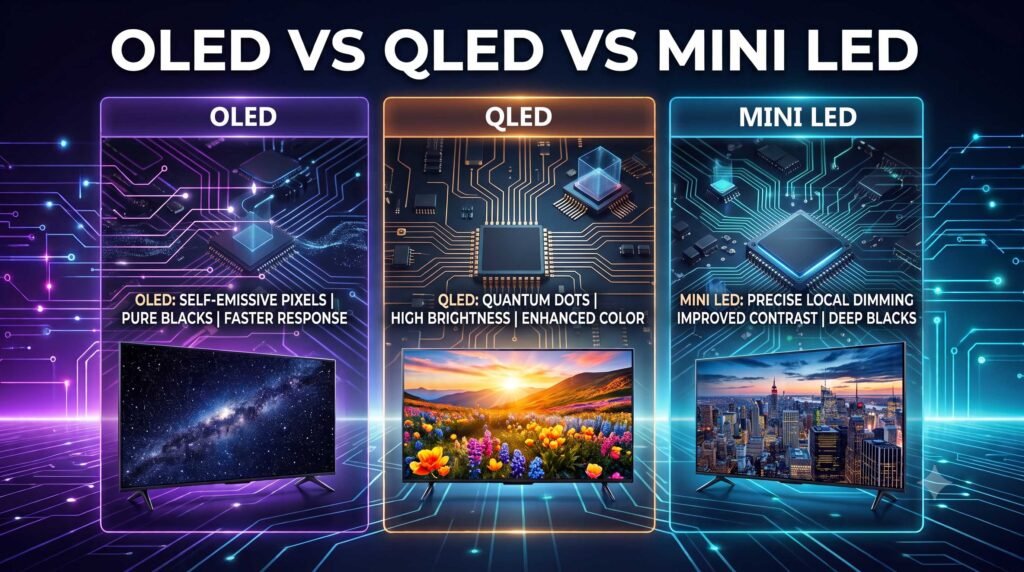
If you’ve started shopping for a new TV in the last year, you’ve probably run into a wall of confusing acronyms. oled vs qled vs mini led They all sound similar, they all promise “the best picture ever,” and the marketing copy on the box rarely explains what actually makes them different.
Here’s the truth: there’s no single “best” technology that wins every category. Each one makes different tradeoffs between brightness, contrast, color, price, and longevity. The right choice depends entirely on your room, your budget, and what you actually watch.
Let’s break down what’s really going on inside these screens, so you can stop guessing and start choosing.
The Quick Answer (For Those in a Hurry)
- Choose OLED if you want the best possible picture quality, watch in a dim or dark room, and don’t mind paying a premium.
- Choose Mini LED if you want a bright, vivid picture for a sunlit living room, watch a lot of sports, and want strong performance without OLED pricing.
- Choose QLED if you’re working with a tighter budget but still want punchy colors and solid brightness for everyday use.
Now let’s get into why.
What Is OLED?
OLED stands for Organic Light-Emitting Diode. Unlike traditional LED TVs, an OLED panel doesn’t need a separate backlight. Every single pixel produces its own light and can switch off completely when a scene calls for true black.
This self-lighting pixel structure is why OLED has been considered the gold standard for picture quality for years. When a pixel turns off, it doesn’t dim — it goes completely dark, right next to a pixel that might be blindingly bright. That creates an almost infinite contrast ratio, which is the single biggest factor in how “real” and three-dimensional an image looks.
OLED Strengths
- Perfect blacks and infinite contrast — no blooming or glowing around bright objects on a dark background
- Incredible viewing angles — the picture looks the same whether you’re dead center or off to the side
- Faster pixel response times — great for fast motion, gaming, and sports
- Thinner, lighter panels since there’s no backlight layer
OLED Weaknesses
- Lower peak brightness compared to Mini LED, which can be a problem in bright rooms
- Risk of burn-in with static images left on screen for extended periods (rare in normal use, but a real concern for people who leave news tickers or video game HUDs on screen for hours daily)
- Higher price tag, especially at larger screen sizes
What Is QLED?
QLED stands for Quantum Dot LED. Despite the name similarity to OLED, it’s a completely different technology under the hood. QLED is still an LED-backlit LCD TV — it just adds a layer of quantum dots in front of the backlight to boost color volume and brightness.
Think of QLED as traditional LCD technology with a serious color upgrade. The quantum dot film converts backlight into more precise, vivid colors than a standard LCD panel could produce on its own.
QLED Strengths
- Excellent brightness, making it a strong choice for rooms with lots of natural light
- Vivid, saturated colors thanks to the quantum dot layer
- No burn-in risk, since it’s LCD-based technology
- More affordable than OLED and Mini LED at comparable sizes
QLED Weaknesses
- Weaker black levels — because QLED still relies on a backlight, true black is difficult to achieve
- Blooming or haloing can appear around bright objects on dark backgrounds, since backlight zones aren’t as precisely controlled
- Narrower viewing angles than OLED
What Is Mini LED?
Mini LED is really an evolution of QLED and standard LED-backlit LCD technology, not a separate category from scratch. The core idea: instead of using a handful of large LEDs to light up the whole screen, Mini LED packs in thousands of much smaller LEDs, organized into hundreds or even thousands of local dimming zones.
More zones means more precise control over which parts of the screen get bright and which stay dark, which closes a lot of the contrast gap that used to separate LCD-based TVs from OLED.
Many premium Mini LED TVs also use quantum dots on top of the mini LED backlight, essentially combining both technologies for maximum brightness and color together.
Mini LED Strengths
- Extremely high peak brightness, often the brightest option on the market
- Improved contrast and reduced blooming compared to standard QLED, thanks to more precise local dimming zones
- No burn-in risk
- Great HDR performance, since HDR content benefits enormously from high brightness peaks
Mini LED Weaknesses
- Still not true per-pixel dimming, so some blooming can still occur in zones with mixed content
- Can be pricier than standard QLED, sometimes approaching OLED pricing at larger sizes
- Viewing angles are better than QLED but still don’t match OLED
Head-to-Head oled vs qled vs mini led Comparison
| Feature | OLED | Mini LED | QLED |
| Black levels | Perfect | Very good | Good |
| Peak brightness | Good | Excellent | Very good |
| Contrast ratio | Best | Very good | Good |
| Color volume | Excellent | Excellent | Very good |
| Viewing angles | Best | Good | Fair |
| Burn-in risk | Low but present | None | None |
| Best for bright rooms | No | Yes | Yes |
| Best for dark rooms | Yes | Good | Fair |
| Price | Highest | Mid-to-high | Most affordable |
Which One Should You Actually Buy?
If You Mostly Watch Movies at Night
Go with OLED. The deep blacks and infinite contrast make dark, moody scenes and cinematic content look dramatically better than anything LCD-based can produce. This is where OLED’s picture quality advantage is most obvious.
If Your Living Room Has Big Windows
Go with Mini LED. Ambient light is the enemy of OLED’s dark-scene advantage, since bright sunlight washes out contrast regardless of panel technology. Mini LED’s high brightness output cuts through glare and daylight far more effectively.
If You’re Watching a Lot of Sports
Mini LED again tends to be the sweet spot, combining high brightness for well-lit broadcasts with fast response times and strong motion handling.
If You’re Gaming Competitively
OLED’s near-instant pixel response time and low input lag make it a favorite among serious gamers, though modern Mini LED panels have closed the gap significantly and often include high refresh rates at more accessible prices.
If Budget Is Your Main Constraint
QLED remains the most cost-effective way to get vivid colors and solid all-around performance, particularly at larger screen sizes where OLED and Mini LED pricing climbs quickly.
A Word on Longevity and Burn-In
A lot of shoppers get unnecessarily nervous about OLED burn-in. For the vast majority of people — those who watch a mix of content and don’t leave static images on screen for hours every single day — burn-in is a non-issue with modern panels, which include pixel-shifting and other protective technologies. If you’re a heavy user of things like 24-hour news channels or you use your TV as a computer monitor with a fixed taskbar, Mini LED or QLED removes that concern entirely.
The Bottom Line
There isn’t a universal winner here, and any article that tells you otherwise is oversimplifying. What you’re really choosing between is a set of tradeoffs:
- OLED gives you the best possible contrast and color accuracy, at the cost of peak brightness and a higher price.
- Mini LED gives you brightness and strong all-around contrast, making it the most versatile choice for varied lighting conditions.
- QLED gives you vivid color and brightness at the most accessible price point, with some compromise on contrast.
Think about where your TV will live, what you watch most, and how much you’re willing to spend — then match that against the strengths above. That’s a far more reliable way to choose than chasing whichever acronym has the flashiest marketing this year.